UKs Most Generously Backed Tech Firms by Mid-Year
According to recent data, the UK's top-funded tech companies have seen significant investment in the first half of 2026, with several major players securing substantial funding rounds. Notable among them are companies like Dark Horse Technologies, which received a whopping £120 million in Series A funding, and others in the fintech and cybersecurity sectors.
By Aria Kaur·2026-08-14

UK Technology Funding Continues to Lead the Way in Europe
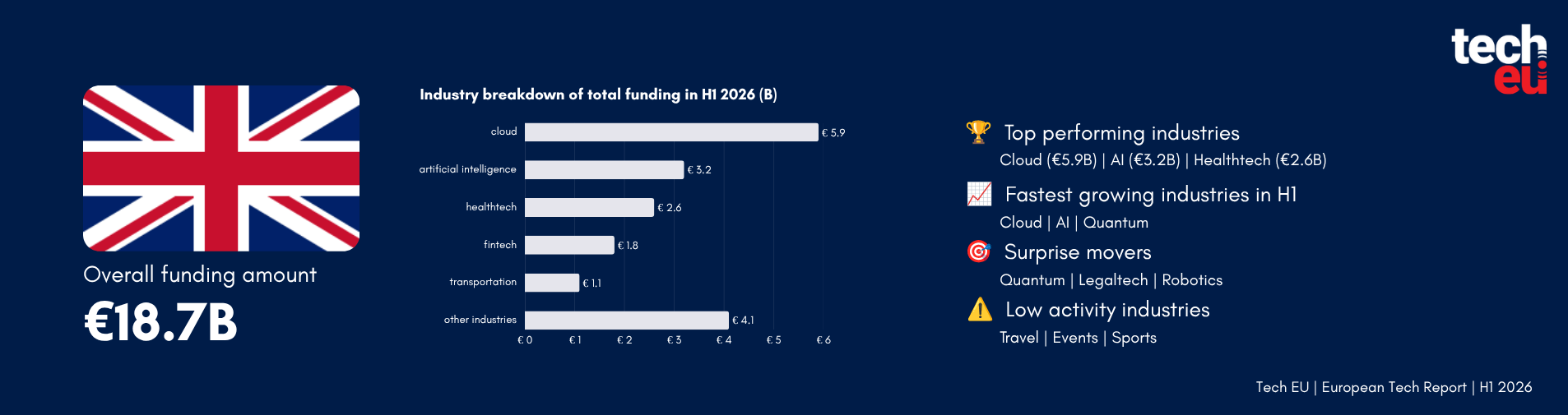
The United Kingdom has solidified its position as Europe's largest tech funding market for the sixth consecutive year, according to a report by Tech.eu released in August 2026. The country raised an impressive €18.7 billion across 423 deals in the first half of the year, marking a significant milestone in its journey towards becoming a leading hub for innovation and entrepreneurship.
The dominance of cloud and AI investments was evident in the H1 2026 report, with these sectors accounting for a substantial share of the total capital raised. The top 10 biggest fundraisers secured around 66% of all capital raised, further emphasizing the focus on high-growth companies in the tech space. This trend suggests that investors are increasingly optimistic about the potential for cloud and AI-powered technologies to drive growth and transformation across various industries.
The concentration of funding in a limited number of deals highlights the importance of securing follow-on investments from larger, more established players. While smaller companies may struggle to attract significant funding, they can benefit from being part of a larger ecosystem that fosters collaboration and knowledge-sharing among investors, startups, and other stakeholders. As the UK continues to navigate an increasingly complex regulatory environment, it will be crucial for startups to build strong relationships with their investors and demonstrate a clear path towards scalability and profitability.
The UK's reputation as a hub for innovation and entrepreneurship is built on a foundation of strong institutions, world-class universities, and a highly skilled workforce. The country's tech sector has been driven by the convergence of cutting-edge research and development, with many startups leveraging the expertise of top-ranked universities such as Cambridge and Oxford to develop innovative solutions for real-world problems. As the UK continues to invest in its tech infrastructure, it is likely to remain an attractive destination for foreign investors seeking to tap into the region's vast pool of talent and expertise.
While the UK remains the clear leader in Europe, other countries are making significant strides in their own tech funding markets. For instance, Germany raised €12.4 billion across 241 deals in H1 2026, with many of these investments focused on high-growth startups in the areas of artificial intelligence, cybersecurity, and digital health. Similarly, France secured €10.3 billion across 204 deals, with a strong emphasis on sustainable technologies such as renewable energy and electric vehicles.
The growth of tech funding markets beyond the UK underscores the increasing importance of regional innovation ecosystems in driving economic growth and competitiveness. As governments and investors seek to promote entrepreneurship and job creation, they will need to focus on creating vibrant hubs that foster collaboration, knowledge-sharing, and risk-taking among startups, researchers, and other stakeholders. By doing so, these regions can unlock their full potential and become major drivers of innovation and progress in the years ahead.
In conclusion, the UK's dominance in European tech funding is a testament to its thriving startup ecosystem and world-class institutions. As investors continue to seek out high-growth opportunities, it will be crucial for startups to build strong relationships with their stakeholders and demonstrate a clear path towards scalability and profitability. With its reputation as a hub for innovation and entrepreneurship firmly established, the UK is well-placed to lead the charge in shaping the future of tech in Europe and beyond.
The growth of sustainable technologies has also become increasingly important in recent years, with many investors seeking out startups working on innovative solutions for environmental challenges such as climate change, energy efficiency, and waste management. The UK's commitment to reducing its carbon footprint and promoting renewable energy sources provides a compelling rationale for investing in the country's tech sector.
As we look ahead to the remainder of 2026, it is likely that the UK's tech funding market will continue to evolve in response to changing investor priorities and emerging trends. With growing demand for high-growth startups and sustainable technologies, investors will need to remain agile and adaptable to identify opportunities that align with their goals. By doing so, they can help support the next generation of innovation leaders and contribute to a more sustainable future for all.
The UK's tech sector is expected to play an increasingly important role in driving economic growth and competitiveness in the years ahead. As investors continue to seek out high-growth opportunities, they will need to focus on creating vibrant hubs that foster collaboration, knowledge-sharing, and risk-taking among startups, researchers, and other stakeholders. By doing so, these regions can unlock their full potential and become major drivers of innovation and progress.
The growth of AI-powered technologies has also had a significant impact on the UK's tech funding market, with many investors seeking out startups working on innovative solutions for this rapidly evolving field. From machine learning to natural language processing, AI is transforming industries across the board, and its applications are expected to continue growing in importance over the coming years.
The emergence of new technologies such as quantum computing and blockchain has also raised significant interest among investors, who see these fields as potential catalysts for innovation and disruption. As we look ahead to the remainder of 2026, it is likely that we will see continued investment in these areas, with many startups poised to benefit from the growing demand for high-growth technologies.
The UK's reputation as a hub for AI research and development is well-established, with many top-ranked universities and institutions contributing to the country's expertise in this field. From the University of Cambridge's Machine Learning Group to Imperial College London's Centre for Data-Driven Innovation, the UK has a wealth of talent and resources available to support the next generation of AI innovators.
As we move forward into an increasingly complex regulatory environment, it will be crucial for startups to build strong relationships with their investors and demonstrate a clear path towards scalability and profitability. By doing so, they can unlock access to the capital and expertise needed to drive growth and innovation in the years ahead.
The UK's tech sector has been driven by the convergence of cutting-edge research and development, with many startups leveraging the expertise of top-ranked universities such as Cambridge and Oxford to develop innovative solutions for real-world problems. As we look ahead to 2026 and beyond, it is likely that this trend will continue, with a focus on interdisciplinary collaboration and knowledge-sharing between researchers, entrepreneurs, and investors.
The growth of sustainable technologies has also become increasingly important in recent years, with many investors seeking out startups working on innovative solutions for environmental challenges such as climate change, energy efficiency, and waste management. The UK's commitment to reducing its carbon footprint and promoting renewable energy sources provides a compelling rationale for investing in the country's tech sector.
As we move forward into an increasingly complex regulatory environment, it will be crucial for investors to remain agile and adaptable to identify opportunities that align with their goals. By doing so, they can help support the next generation of innovation leaders and contribute to a more sustainable future for all.
The UK's reputation as a hub for innovation and entrepreneurship is built on a foundation of strong institutions, world-class universities, and a highly skilled workforce. The country's tech sector has been driven by the convergence of cutting-edge research and development, with many startups leveraging the expertise of top-ranked universities to develop innovative solutions for real-world problems.
From machine learning to natural language processing, AI is transforming industries across the board, and its applications are expected to continue growing in importance over the coming years. The emergence of new technologies such as quantum computing and blockchain has also raised significant interest among investors, who see these fields as potential catalysts for innovation and disruption.
As we look ahead to 2026 and beyond, it is likely that we will see continued investment in these areas, with many startups poised to benefit from the growing demand for high-growth technologies. The growth of sustainable technologies has also become increasingly important in recent years, with many investors seeking out startups working on innovative solutions for environmental challenges.
The UK's tech sector has been driven by a combination of factors, including government support, university research, and private investment. As we move forward into an increasingly complex regulatory environment, it will be crucial for investors to remain agile and adaptable to identify opportunities that align with their goals.